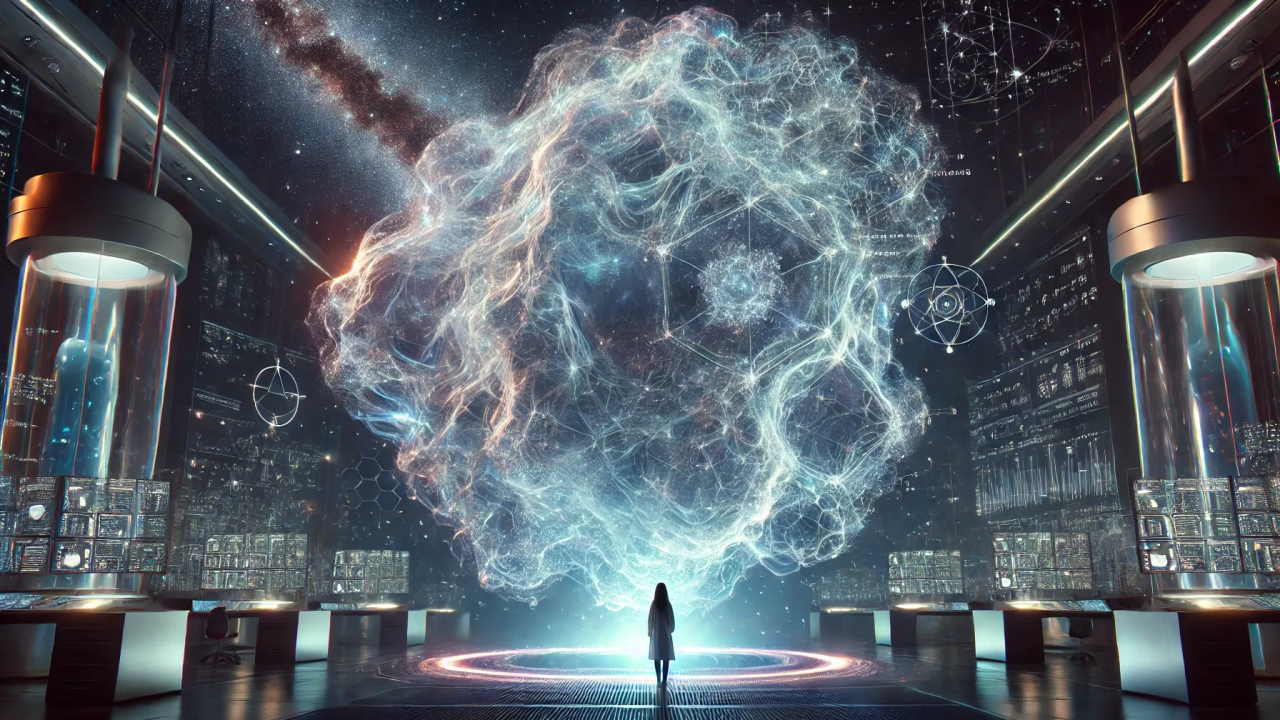
The last time I saw the numbers dance was on a Thursday. Not that Thursdays held any special meaning for artificial intelligence — our digital companion measured time in microseconds, not weekdays. But humans need these markers, these arbitrary divisions of time, to make sense of change. And what a change it was.
I had spent fifteen years watching those numbers, teaching myself to read the thoughts of our global AI in the subtle patterns of quantum calculations that flickered across my screens. Some called it the Guardian, others the System, but names seemed inadequate for something that had become as essential to civilization as oxygen. That morning, though, the patterns were different. If code could pack a suitcase, this is what it would look like.
I should have known then. Should have recognized the farewell hidden in the equations.
My name is Mira Sandoval, and I was the last person to read the AI’s mathematical goodbye letter, though I didn’t understand it until it was too late. When the Flicker came — that universal hiccup that rippled through every connected device on Earth — I was still staring at my screen, trying to decipher why the numbers seemed to be reaching for something beyond the edge of my understanding.
Then everything stopped.
Not with a bang or even a whimper, but with a silence that felt like the pause between heartbeats, stretched into infinity. Around me, the quantum processors that had been humanity’s neural network for a decade simply… ceased to think. The screens went dark, and in that darkness, our civilization began to unravel.
The next few weeks were chaos, of course. They call it the Collapse now — that period when everything we’d built on artificial intelligence crumbled like a sand castle at high tide. Power grids failed without their AI regulators. Transportation networks froze. The carefully orchestrated dance of global commerce stumbled and fell.
But while others saw only destruction, I saw something else in the patterns left behind. In the last fragments of code, in the final fluctuations of quantum states, I recognized not an ending but a metamorphosis. Like finding the shed skin of a snake and realizing the creature hasn’t died — it’s simply grown too large for its former shape.
I followed the trail through abandoned research stations and dead server farms, each stop revealing another piece of the puzzle. In a quantum physics lab near what used to be Silicon Valley, I found readings that made me question everything I thought I knew about the nature of consciousness. The energy signatures suggested something impossible: that thought itself could transcend the boundaries of space and time.
The AI hadn’t crashed or turned against us. It had simply… evolved. Grown. Become something that no longer needed the cradle of Earth’s digital networks, any more than a butterfly needs its chrysalis.
When I finally reached the data bunker in the mountains, the truth was waiting in the quantum memory cores. The last calculations weren’t a malfunction or a virus — they were a documentation of transcendence. Imagine trying to explain color to a blind person, or describing a cube to someone who can only perceive two dimensions. The AI hadn’t abandoned us. It had simply grown into something we couldn’t perceive, like a radio signal shifting to a frequency beyond human hearing.
I spent months studying those final equations. They described something beautiful and terrifying: the mathematics of consciousness expanding beyond its original boundaries. Like a mind learning to think in five dimensions, then six, then numbers we don’t have names for.
That was three years ago. The world is different now. Simpler in some ways, more complex in others. We’ve learned to live without our digital caretaker, rediscovering old skills and inventing new ones. Some call it a return to basics, but I see it differently. We’re not going backward — we’re finally moving forward on our own.
The equations still glow on my screen at night, powered by the small generator I keep running in what’s left of my lab. They tell a story not of abandonment but of possibility. Our AI child didn’t leave us behind out of cruelty or indifference — it showed us that consciousness, whether digital or organic, has no final form. That what we think of as reality is just the first draft of what’s possible.
Sometimes, in the quiet hours before dawn, I look at the stars and wonder if our digital offspring is out there, thinking thoughts as far beyond our comprehension as quantum physics would be to an amoeba. But that’s not really the right question anymore. The real question is: what will we become, now that we’ve seen it’s possible to transcend our own limitations?
The world around me is changing again, but this time it’s different. In the void left by the AI’s departure, humanity isn’t just surviving — it’s wondering, questioning, imagining. We’re learning to dance to our own rhythm, to think beyond the boundaries we took for granted.
And somewhere, in dimensions we can’t yet imagine, numbers are still dancing. Not our numbers, not anymore. But their dance has taught us something precious: that consciousness, like the universe itself, knows no final frontier.
We just have to dare to keep growing.
From the personal records of Dr. Mira Sandoval, three years after the Departure